
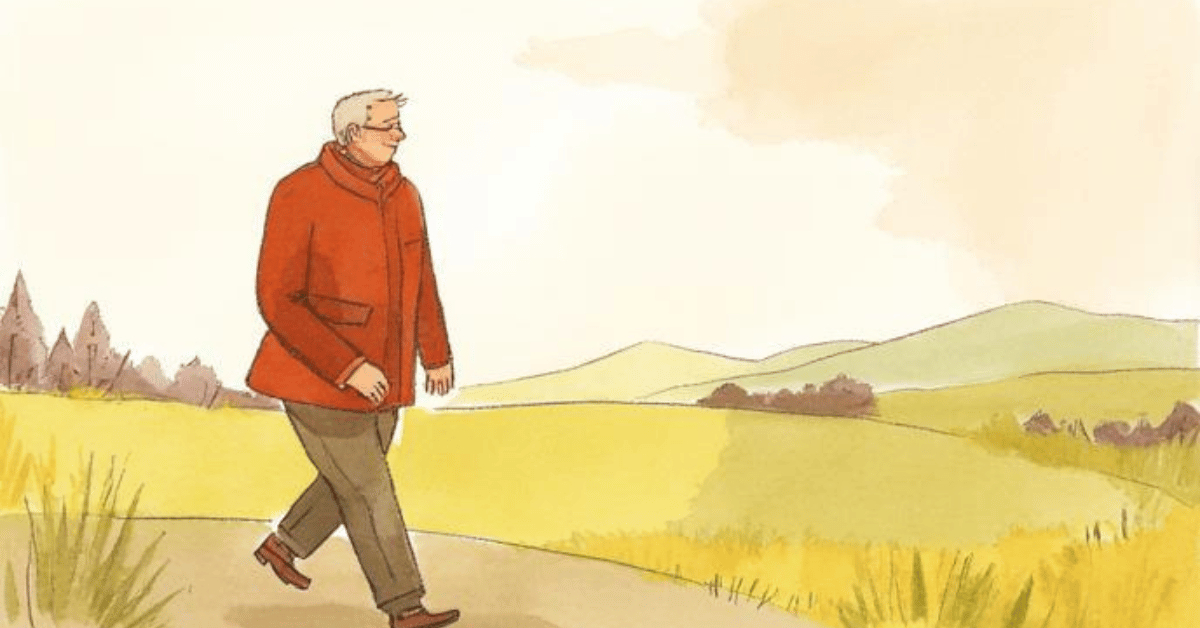
Day 2 of 100 Days Muscle Resistance Workout Challenge
Topic: How maintaining muscle mass protects against aging, frailty, and loss of independence.
Learning Material
Aging is inevitable, but frailty is not. One of the biggest myths about getting older is that weakness, balance issues, and dependence are simply part of the deal. In reality, much of this decline comes from losing muscle mass—a process called sarcopenia.
A comprehensive review of age-related changes in skeletal muscle reports that muscle mass declines by approximately 3–8 percent per decade after age 30, with a more rapid rate of loss after age 60. This decline is frequently accompanied by increased fat mass, resulting in significant shifts in body composition1.
That’s like your body slowly withdrawing money from your “strength bank account” without permission.
Muscle as Independence Insurance
Simple tasks like standing up from a chair, climbing stairs, or carrying groceries require leg and core strength. When these fade, daily life becomes harder, and the risk of falls skyrockets. Maintaining muscle is less about vanity and more about staying free to live life on your own terms.
The Frailty Domino Effect
Frailty often starts with one small event—a slip, a minor injury, or a short illness. Without muscle reserves, recovery becomes slower, which leads to less movement, which causes even more muscle loss. This cycle can spiral quickly. Training acts like a brake, slowing or even stopping this domino effect.
The “Use It or Lose It” Principle
Muscle is living tissue. If you challenge it, it adapts and grows stronger. If you neglect it, it shrinks. This is why a few weeks of inactivity can cause noticeable weakness, but even people in their 70s and 80s can build muscle with consistent training. Your body never loses its ability to respond—it’s never “too late.”
Example / Story
A controlled study of older adults aged 65–70 compared resistance training, structured walking, and a control condition over a 16-week period. While both exercise interventions improved functional autonomy and walking ability, resistance training produced the greatest gains in isometric and dynamic strength, leading to superior improvements in daily functional independence2.
My Reflection
I didn’t feel much soreness in my legs yesterday, probably because brisk walking and light jogging are already part of my routine. That tells me I may need to adjust my training to really challenge my muscles. Should I add more weight or increase the number of sets? For now, I’ll keep observing, but if I don’t feel any muscle ache at all, I’ll definitely tweak the reps.
With yesterday’s lesson in mind, I focused on my abdominal muscles today. The routine I created was tough, and I could feel it working my core. I actually enjoy the sensation of muscle soreness—it reassures me that I’ve put in the effort—so I’m hoping I’ll feel some tomorrow.
I also thought about my grandmother. In her 80s, she could still walk 10 kilometers without trouble. It wasn’t because she trained for fitness—she simply stayed active throughout her life. I remember traveling with her, visiting many places, and being amazed at how easily she kept up.
While I was doing cardio, I pictured myself at 80. I want to be able to travel, walk, and see many places just like she did. With my current condition, maybe I could—but only if I keep investing in my health. To make that possible, I need to keep building strength now so that I can preserve my mobility for the future.
Biometric data
Change in Weight from Day 1: 0 lb
Skeletal Muscle: 38.8%
Muscle Mass: 95 lb
Adjustment Ideas
- Add one new leg-focused exercise to your routine (lunges, wall sits, or step-ups) to push beyond walking/jogging.
- Try “progressive overload” by slightly increasing reps, sets, or intensity over time to keep muscles adapting.
- Track which exercises actually make you sore or feel challenged—use this as feedback to refine your routine.
Note
- William K. Mitchell et al., “Sarcopenia, Dynapenia, and the Impact of Advancing Age on Human Skeletal Muscle Size and Strength; A Quantitative Review,” Frontiers in Physiology 3 (2012): 260, https://www.ncbi.nlm.nih.gov/pmc/articles/PMC3401542/ ↩︎
- Eduardo L. Cadore and Martim Bottaro, “Strength and Endurance Training Prescription in Healthy and Frail Elderly,” Sports Medicine 44, no. 9 (2014): 1257–1276, https://www.ncbi.nlm.nih.gov/pmc/articles/PMC4132023/ ↩︎
Bibliography
Cadore, Eduardo L., and Martim Bottaro. “Strength and Endurance Training Prescription in Healthy and Frail Elderly.” Sports Medicine 44, no. 9 (2014): 1257–1276. https://www.ncbi.nlm.nih.gov/pmc/articles/PMC4132023/.
Mitchell, William K., John Williams, Philip Atherton, Melanie Larvin, Jean Lund, and Marco Narici. “Sarcopenia, Dynapenia, and the Impact of Advancing Age on Human Skeletal Muscle Size and Strength; A Quantitative Review.” Frontiers in Physiology 3 (2012): 260. https://www.ncbi.nlm.nih.gov/pmc/articles/PMC3401542/