
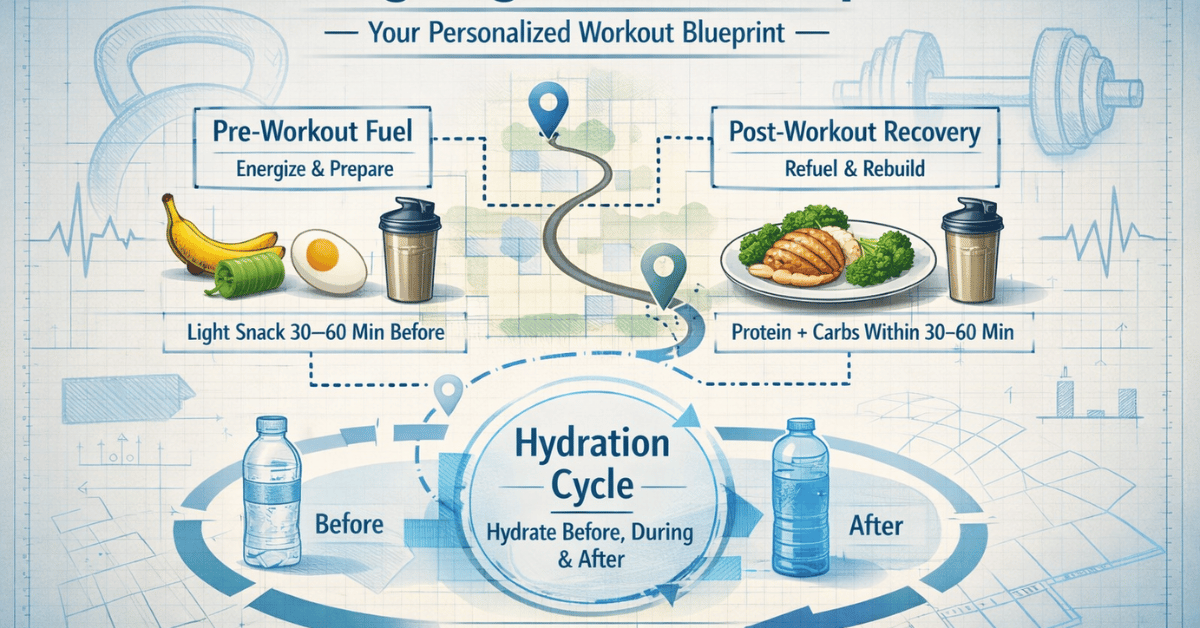
Designing Your Fuel Map: Build a Personalized Workout Fueling Blueprint

Day 42 of 100 Days Muscle Resistance Workout Challenge

Focus Topics: Review what pre/post-workout meals or hydration strategies worked best.

Learning Material 

By now, you’ve learned that nutrition isn’t just about what you eat; it’s about timing, balance, and feedback. Last week focused on understanding your body’s relationship with energy: how hydration supports endurance, how carbs fuel performance, and how protein rebuilds strength.

Now it’s time to bring all these insights together and create your personal fueling blueprint, a system tailored to your body’s rhythm, workout style, and goals. Think of this as your “map” for sustainable progress.

Key Insight

1. Find Your Pre-Workout Sweet Spot

Not everyone thrives on the same pre-workout strategy. Some feel best training fasted, while others need a small carb or protein boost beforehand. The key is understanding how your body responds to fuel timing.

  • If you train early in the morning: Try a light, easily digestible snack, like a banana or protein shake.
  • If you train later in the day: Focus on a balanced meal 2–3 hours before training with carbs (for energy), protein (for muscle protection), and some fat (for sustained fuel).

Research shows that even small pre-exercise meals improve muscle activation and endurance by maintaining stable blood sugar and reducing fatigue.

Key Insight 1: Experimentation builds awareness. Your body’s “fuel pattern” is unique; listen, track, and adapt.

2. Perfect the Post-Workout Window

Recovery begins the moment your workout ends. The goal is to replenish glycogen, repair muscle tissue, and restore hydration. Studies indicate that consuming protein and carbohydrates shortly after exercise enhances muscle protein synthesis and glycogen replenishment more effectively than delaying intake for several hours.1

Effective recovery combinations:

  • Greek yogurt + fruit
  • Chicken + rice bowl
  • Protein shake + banana
  • Tofu + sweet potato

If you work out intensely or multiple times per week, adding electrolytes or lightly salted water can further support recovery.

Key Insight 2: Think of your post-workout meal as a continuation of your workout—it’s part of the training, not the reward after it.

3. Hydration: The Constant Factor

Your energy and performance fluctuate with hydration. Even mild dehydration (as little as 2% body weight loss) can cause noticeable drops in power and endurance.

A good guideline:

  • 2 cups (500 ml) of water before exercise
  • Small sips every 15–20 minutes during exercise
  • 2–3 cups after, adjusted for sweat loss

Add electrolytes if your sessions last over an hour or you sweat heavily. Remember, hydration isn’t just about replacing water. It’s about restoring balance.

Key Insight 3: Hydration consistency is like charging a phone; you can’t expect full power if you only plug in when the battery’s already dying.

Real-World Example: The “Goldilocks” Athlete

One runner kept struggling with energy crashes mid-race. After journaling her nutrition, she realized she was under-fueling pre-run but overloading post-run. By adjusting her intake, half a banana before training and a recovery shake afterward, she found her “just right” balance.
Her endurance improved, and recovery time dropped significantly.

Like her, your goal this week is to identify your “Goldilocks zone,” the nutrition rhythm that feels sustainable, not forced.

My Reflection

Having a morning snack has been a challenge for me. If I want to make it a consistent habit, I’ll need to adjust my routine altogether. I’ve been weighing myself after workouts to keep track of my progress, but I realize it might be more accurate to weigh myself before exercising and after eating a small pre-workout snack.

My favorite meal combination is eggs and salad, simple but effective. I use balsamic vinegar and black pepper as a dressing, which adds nice flavor without extra calories. Eggs are my go-to because they provide a solid amount of protein, and I prefer eating them before starting work since I can’t cook once my workday begins.

I also have strawberries and homemade yogurt. My yogurt doesn’t contain preservatives or added sugar, which makes it a clean option. The only issue is convenience; I often skip it because it takes about 10 minutes to prepare. I’m planning to cut and portion the strawberries ahead of time so it’s easier to eat in the mornings.

During work hours, I take a plant-based protein shake since it’s quick to prepare and allows me to mix different protein sources.

Last week, I noticed a small reduction in my stabilized weight, but also a slight drop in muscle mass. I’ll continue monitoring both closely and stay mindful of my eating habits. Food journaling helps me see patterns clearly.

I also increased the weight for my leg workouts this week since I wasn’t feeling muscle soreness anymore. I’m curious to see if the new adjustment will stimulate better results.

Biometric data

Change in Weight from Day 1: -3.2 lb.
Skeletal Muscle: 39.3%
Muscle Mass: 94.6 lb.

Adjustment Ideas (Strategic Adjustment)

  1. Refine Your Timing: Adjust pre-workout fuel 30 minutes earlier or later and note performance changes.
  2. Prioritize Recovery: Prep a ready-to-go post-workout protein or carb option so you never skip your refueling window.
  3. Hydrate with Intention: Track daily water intake (aim for half your body weight in ounces) and note how it affects energy and muscle soreness.

Note

  1. Ivy, John L., Howard W. Goforth Jr., Bruce M. Damon, et al. “Early Postexercise Muscle Glycogen Recovery Is Enhanced with a Carbohydrate-Protein Supplement.” Journal of Applied Physiology 93, no. 4 (2002): 1337–1344. https://doi.org/10.1152/japplphysiol.00394.2002 ↩︎

Recharge Like a Pro: The Hidden Power of Hydration

Day 38 of 100 Days Muscle Resistance Workout Challenge

Focus Topics: Hydration for energy and recovery. Learn the role of water and electrolytes in energy and recovery.

Learning Material 

If protein builds your muscles and carbs fuel your workouts, water is what makes it all possible. Hydration isn’t just about quenching thirst; it’s about keeping your cells, muscles, and brain in balance. Even mild dehydration can reduce strength, slow reaction time, and make a workout feel twice as hard.

Think of water as the transport system for everything your body needs: oxygen, nutrients, hormones, and energy. Without it, even the best nutrition plan or workout routine loses its efficiency.

Key Insight

1. Why Hydration Matters More Than You Think

Your body is roughly 60% water, and muscles are even higher, around 75% water. When you sweat, you don’t just lose water; you also lose electrolytes, minerals like sodium, potassium, calcium, and magnesium, that regulate muscle contractions, nerve signals, and fluid balance.

When these minerals drop, you might experience:

  • Fatigue or muscle cramps
  • Slower reaction time
  • Headaches or lightheadedness
  • Reduced strength output

Even a 2% drop in hydration can lead to measurable performance decline. That’s why athletes and trainers call water the most underrated performance enhancer.

2. The Science of Energy and Water

Hydration affects how your body produces and uses adenosine triphosphate (ATP)—the energy currency that powers every muscle contraction. When you’re dehydrated, blood volume decreases, forcing your heart to work harder to deliver oxygen to muscles. That leads to faster fatigue and slower recovery.

Meanwhile, electrolytes help maintain electrical impulses that make your muscles move. Sodium and potassium act like tiny batteries—creating voltage differences that trigger muscle contraction and relaxation. When your electrolyte balance is off, your “wiring” misfires, leading to cramps and weakness.

Key insight: Staying hydrated keeps your muscles “electrically charged,” ensuring each rep or stride fires efficiently.

Real-World Example: The Marathon Meltdown

Research on endurance athletes shows that excessive dehydration during long-distance races is associated with increased fatigue, cramping, and declining performance. Studies suggest that performance impairment becomes more likely once body mass loss exceeds approximately 2–3% during endurance exercise. 1

Even in non-athletes, daily dehydration (from skipped water or too much caffeine) leads to brain fog, irritability, and poor sleep quality.

How Much Water Do You Actually Need?

The old “8 cups a day” rule is too generic. A better guideline:

  • Before workout: 2 cups (500 ml) 1–2 hours before exercise.
  • During workout: ½–1 cup (125–250 ml) every 15–20 minutes.
  • After workout: 2–3 cups (500–750 ml) per pound lost during training.

Electrolyte tip:
If you train longer than 60 minutes or sweat heavily, add a pinch of salt, coconut water, or an electrolyte tablet. Natural options like bananas, oranges, or yogurt also help replenish potassium and magnesium.

My Reflection

Hydration is something I care a lot about, as it can literally make me dizzy. I also try to keep my kidneys as clean as possible. Constant dehydration makes my kidneys filter more concentrated liquid, which can create kidney stones.

I lost my muscle mass as I did not eat enough protein on Monday. So I ate a little more protein yesterday and the day before yesterday. It made me gain the muscle mass again, but so did my weight. I should watch out for what I eat more carefully.

Today, I am not going to eat any side dishes because I don’t want to gain any more weight than I would like. 

My goal for this Saturday and Sunday. I am going to do a longer workout. 

Biometric data

Change in Weight from Day 1: -2.6 lb.
Skeletal Muscle: 39.10%
Muscle Mass: 94.6 lb.

Adjustment Ideas (Strategic Adjustments)

  1. Hydration Habit Stack: Keep a full bottle near your workout gear. Drink 1 cup before your warm-up and finish the rest after training.
  2. Smart Electrolyte Boost: Add a small amount of sea salt or electrolyte mix to one bottle per day—especially after leg days or hot-weather workouts.
  3. Caffeine Check: Balance every cup of coffee or tea with an equal amount of water. Caffeine is mildly dehydrating and can impact performance if not offset.

Note

  1. Judge, Lawrence W., et al. “Hydration to Maximize Performance and Recovery.” Strength and Conditioning Journal 43, no. 4 (2021): 32–42. https://pmc.ncbi.nlm.nih.gov/articles/PMC8336541/ ↩︎

How I’m Training Myself to Drink Water Like an Adult

Brian’s fitness journal after a brain stroke

Today’s main objective is simple, practical, and surprisingly difficult: drink water on schedule.

My wife recently bought us matching one-liter water bottles with hour-by-hour drinking markers printed right on them. The idea is elegant—drink steadily throughout the day instead of realizing at 8 p.m. that you’ve consumed approximately nothing.

Everyone should drink water regularly, kidney issues or not. In my case, it’s non-negotiable. My doctor reminds me—firmly—that I need at least 1.5 liters a day. Concentrated urine is not something my already overworked kidneys appreciate, and kidney stones are absolutely not on my wish list.

The problem is not knowing this.
The problem is forgetting.

Over the past week, my routine has been hijacked by distractions: lab appointments, our anniversary dinner, Thanksgiving. All good things—but all excellent at pulling me away from my desk, my notebook, and any awareness of hydration. By the time I noticed, I was hours behind.

So I did what any desperate person would do: I guzzled water to catch up.

This was a mistake.

My body did not appreciate the late-day hydration sprint and politely informed me of its displeasure by waking me up in the middle of the night with a bladder emergency. Lesson learned: hydration is not a cram session.

My wife bought these bottles because she forgets to drink water when she’s writing, reading, or deeply focused on anything at all. She wisely bought one for me too, because I apparently have the same flaw.

Before this bottle, I had no real sense of how much water I was drinking. Now I can see it clearly—and unfortunately, that clarity revealed that several days last week ended with frantic water catch-up. There’s no good excuse for that.

We buy five-gallon jugs from the grocery store and use a water dispenser at home. Between the two of us (and occasional help from the refrigerator dispenser), we now go through about five gallons a week. Ever since getting these bottles, that number has become very consistent—which strongly suggests we were under-hydrating before.

So today, I’m doing things differently. No catch-up drinking. No late-night flooding. Just steady, boring, responsible hydration—one hour mark at a time.If all goes well, my reward will be the most luxurious thing of all:
an uninterrupted night’s sleep.

My Water Bottle is Now My Boss

Written March 8, 2025

Hello Dear Readers,

Yesterday, I embarked on a noble quest—one that involves discipline, perseverance, and a very bossy water bottle. My wife, in her infinite wisdom (and slight exasperation with my forgetfulness), got us matching bottles with a hydration schedule printed on the side. Every hour, there’s a new line taunting me, reminding me to drink up before I inevitably fail my kidneys again. The concept is brilliant: sip gradually instead of realizing at 3 p.m. that I haven’t had a drop of water all day and then chugging a ridiculous amount like I’m a lost traveler in the desert.

As someone with chronic kidney disease, hydration isn’t just a good idea—it’s non-negotiable. But here’s the problem: I forget. A lot. When I do remember, I go into panic mode and overcompensate, leading to an uncomfortable, sloshy-stomach situation that’s about as pleasant as wearing wet socks. This bottle might just save me from myself.

Of course, the real test will be summer. When the sun’s out, I’m outside more, blissfully unaware that my body is slowly turning into a raisin. Dehydration and I have a long history, and my lab results have suffered for it. My doctor gently (read: sternly) reminds me that my kidneys don’t appreciate my forgetfulness. So, this summer, I plan to stick to the hydration schedule like my health depends on it—because, well, it does.

This whole thing got me thinking: where was this hydration discipline when I was younger? I never had the instinct to reach for water like my wife does. Not that I was drowning in soda or anything, but I definitely consumed more sugary drinks than necessary. Meanwhile, my wife has always been ahead of the health game. She avoids sugar like it’s plotting against her (which, in fairness, it kind of is—diabetes runs in her family). No soda, no alcohol, and a highly disciplined approach to carbs. She loves pasta and rice, but you’d never know it from how sparingly she eats them. Instead, she fills her plate with sweet potatoes, carrots, and the occasional apple in her salad. Apparently, those count as her sweet treats.

For me, adopting a healthier lifestyle isn’t so much a choice as it is a medical necessity. But I have to admit, having a wife who’s already on board with the whole “let’s not wreck our bodies” philosophy makes things a lot easier. She’s seen firsthand what happens when health is neglected, so she naturally supports my restrictions without making it a big deal. I’ve said it before, and I’ll say it again: marrying her was my best decision.

This hydration experiment means I’ll be consuming a solid two liters of water daily. Right now, I’m still adjusting to this new reality where my bottle dictates my drinking habits. But with summer just around the corner, I have a feeling this little routine will become second nature. My kidneys, my doctor, and my wife will all be pleased. And hey, maybe I’ll finally stop feeling like a dried-up sponge by midday. One can dream.

Running, Weather, and the Fine Art of Not Wrecking My Kidneys

Written January 30, 2025

Hello Dear Readers,

Yesterday’s run? Surprisingly pleasant. The weather was in that sweet spot—chilly enough to make standing around feel like a questionable life choice but with just enough sun to turn things comfortable once I got moving. It’s that perfect running paradox: too cold to stand still, too warm to bundle up. And best of all? I managed to beat my target pace for the first 5K again, which means I’m still holding onto my ever-diminishing speed goals. A small but satisfying victory.

Now, let’s talk about my body’s complicated relationship with temperature. Ever since my brain stroke, my autonomic nervous system has been a bit of a diva—it no longer regulates heat or cold properly. If the weather swings too far in either direction, my endurance takes a nosedive. Some runners struggle with pacing, others with motivation. I struggle with the fundamental issue of my body, deciding it simply does not approve of temperature extremes. It’s like a toddler refusing to eat anything but macaroni and cheese.

Because of this, I’ve been forced to become a part runner and part-amateur meteorologist. I check the forecast religiously, sometimes more than I check my emails. My weather app claims it can predict the weather up to 10 days in advance, though let’s be honest—it’s basically fortune-telling after a week. Still, it gives me a decent heads-up on what’s coming. And when you have a body that treats temperature changes like a personal betrayal, planning ahead is crucial.

Take tomorrow, for example. Warmer weather is on the way, which means hydration is about to become my new best friend. That also means my pace might start to slow because staying hydrated and pushing for speed don’t always go hand in hand. And here’s where things get tricky. I love progress. I love seeing the numbers on my running app improve. But I also love having functioning kidneys, and unfortunately, one comes at the expense of the other.

Dehydration is bad for anyone, but for me, it’s particularly risky. My kidneys already function at less than full capacity, so letting them get parched isn’t just a bad idea—it’s a potentially dangerous one. Pushing my limits is one thing; actively sabotaging my health is another.

So, if I have to choose between breaking a personal record and keeping my body happy, I’ll choose my health every time. Okay, maybe not happily, but let’s call it a mature decision. It’s the kind of choice I’ll have to keep reminding myself of mid-run, especially when the competitive part of my brain whispers, just a little faster, you can still beat it.

But in the end, running is about longevity, not just speed. And if slowing down a little means I get to keep running for years to come? That’s a trade I’m willing to make even if my inner speed demon protests the entire way.

More Water To Keep My Kidney Healthy

Written July 30, 2024

Hello Dear Readers,

Since my last doctor’s appointment, I’ve become increasingly vigilant about my water intake. The results from my lab tests were a wake-up call, confirming that I was more dehydrated than I should have been. This realization has prompted me to take hydration more seriously, especially considering my compromised kidneys. Proper hydration is crucial for everyone, but it’s even more vital in my case. I’ve made significant changes to my daily routine to ensure I get enough water, particularly during the sweltering summer months when dehydration can sneak up on you quickly.

Living in Nashville, I’m no stranger to hot and humid weather. However, the past few weeks have brought an unusually intense wave of heat and humidity, making daily activities more challenging, especially those outdoors. The weather here has worsened, with temperatures soaring and the air thick with moisture. In response, I’ve had to rethink my outdoor schedule entirely. I’ve started getting up earlier to complete tasks like gardening before the heat becomes unbearable. Even at 7 A.M., stepping outside feels uncomfortable. Still, it’s far better than the near-torturous conditions that develop as the day progresses.

One of the most noticeable changes I’ve made is how I manage my water intake throughout the day. In the past, I might have taken hydration for granted. Still, I’m acutely aware of how much water I need, especially when working outside. Initially, keeping up with my increased water consumption was straightforward. However, as I began drinking more to cope with the heat, I nearly ran out of our water supply. Fortunately, our delivery arrived just in time to replenish our stock, avoiding what could have been a very uncomfortable situation.

Recognizing that our water consumption had increased significantly, we increased our delivery order to three bottles, totaling 15 U.S. gallons. This adjustment has been necessary, as my partner and I have been drinking more water than usual. It’s no surprise, given the oppressive heat. Still, it also made me realize how much I underestimated my hydration needs. Looking back, I can see that I wasn’t drinking nearly enough water, a mistake I can’t afford to make again, especially with my health condition.

This experience has underscored the importance of staying hydrated, particularly in extreme weather. It’s easy to overlook something as simple as drinking enough water, but it’s crucial for maintaining overall health. 

In the future, I plan to continue diligently monitoring my water intake, adjusting as needed depending on the weather and my activity levels. It’s a small change that can make a big difference, ensuring I stay healthy and hydrated no matter how hot it gets outside.

A Delicate Balance of Health and Habit – Staying Hydrated

Written July 6, 2024

Hello Dear Readers,

I’ve meticulously monitored my water intake to ensure my kidneys function more efficiently. I’ve integrated this routine into my daily schedule using my smartphone, as waiting until I feel thirsty usually indicates that I’m already too dehydrated.

Occasionally, my busy schedule leads me to miss these drinking reminders. Just last night, I was behind on my water quota, necessitating a late-evening rush to meet my goals. The result was less than ideal, as I had to wake up several times throughout the night to use the bathroom.

On one hand, it’s reassuring to know that my kidneys are functioning well enough to produce urine actively. I take some comfort in achieving my hydration goals, yet the disruption to my sleep is a trade-off I’m keen to avoid. It would be beneficial to complete my water intake earlier in the evening to minimize nighttime interruptions.

Managing my daily essentials—eating, drinking, exercising, working, and sleeping—sometimes feels overwhelming. Each element is crucial to my health, and maintaining a disciplined schedule seems to be the key to staying on track.

By closely monitoring my progress throughout the day, I aim to consistently meet or exceed my modest goal of 2 liters of water well before it’s time to wind down for bed. This proactive approach helps me stay hydrated and enhances my overall well-being by allowing for uninterrupted rest.

Key To Change Yourself Better Is Leaning From Your Mistakes

Written 6/26/2024

Hello Dear Readers,

Sometimes, taking care of our bodies means working toward improving small things. Recently, I had the experience of getting a disappointing lab result, which turned out to be because I was too dehydrated. I now make sure every day that I drink 1.5 – 2.0 liters of water, which is the recommended intake for my body.

Before my kidney failure, I ignored how much I drank or anything like that. When you get hit with trauma such as a brain stroke, you start to wonder what you have been doing all wrong. Well, there are no benefits in crying about my past. All I had to do was make changes to my lifestyle to sustain my kidneys’ health. It is a trial-and-error process. It is a long process, as sometimes you do not see the results as fast as you want.

After the last lab experience, this will not happen to me again. The level of activities or external environmental factors such as weather can drastically impact your body. Sometimes, I need to adjust the amount of water I am drinking.

Making this little change into a habit is tricky. For example, I started mowing the lawn but needed to remember to take some water. It never occurred to me to bring a water bottle when I did a few hours of mowing. Interestingly, we are all cursed with habit no matter how much we try to change our past behaviors. Now, I know I have to keep hydrating. So, I stopped mowing, got water, and resumed rather than just pushing through without water.

It’s important to reinforce this good decision. Even small steps are worth taking and celebrating if they’re in the right direction. Making sure to stay hydrated is just one of those small steps that can have a big impact on overall health.

I’ve learned through this journey that maintaining health requires continuous effort and adaptation. It’s about listening to your body and making adjustments as needed. Sometimes, it’s easy to get caught up in daily routines and forget the essentials, like drinking enough water. But we can significantly improve our health by being mindful and making small, consistent changes.

For anyone dealing with similar issues, remember that it’s okay to make mistakes. The important thing is you will learn from them. It’s part of the process. The key is to keep trying and not give up. Every small change adds up over time, leading to better health and well-being.

It is crucial to take care of our bodies by making small improvements, like staying properly hydrated. My experience has taught me the importance of paying attention to my body’s needs and making necessary adjustments. It’s a journey of trial and error, but we can achieve a healthier lifestyle with persistence and mindfulness.

Coping with Unexpected Kidney Function Changes

Written June 25, 2024

Hello Dear Readers,

Yesterday went well overall, but I received some concerning news from my nephrologist. Either the labs were taken on an off day for me, or my already compromised kidney function has significantly declined. My log showed no anomalies, so my doctor thinks it was a bad day, possibly due to dehydration. I’m hoping that the previous tests were conducted on such a day. More blood and urine samples were taken to retest, and I should have an update in a few days.

Receiving news like this can be really disheartening. I keep wondering what could have caused the sudden drop in my kidney function. I’ve been doing my best to follow all the recommendations from my doctor. It might be that a recent change in my medication is having an unexpected adverse effect, so reverting to my previous regimen could be necessary.

Regardless, aside from ensuring I continue to do what I know I should be doing, there is little else I can control. My wife always reminds me not to worry about things beyond my control.

There are two things I can improve. I can improve my hydration by not eating more than one Ganoral bar daily. Sometimes, due to the heat, I feel more dehydrated than usual. My doctor mentioned that the Ganora bars I’m taking are protein-based, so he’s not overly concerned, even though I sometimes eat a few of them per day. I just can’t allow myself any excuses for not drinking enough water or over-indulging in snacks.

Hydration Hacks for Outdoor Activities: A Personal Journey with Kidney Care

Written on June 7th, 2024

Hello Dear Readers,

Yesterday was a successful day in my ongoing battle against the ever-growing grass in my yard. As I pushed the mower back and forth under the sweltering sun, I made it a point to keep myself well-hydrated—a critical practice not just for my general health but particularly vital due to my kidney issues.

Hydration is essential for everyone, healthy or otherwise, but it becomes even more crucial when managing kidney dysfunction. While at a rehabilitation center, healthcare professionals emphasized the importance of drinking at least 2 liters of water daily. The kidneys play a pivotal role in filtering our blood and producing urine. Dehydration can lead to a higher concentration of minerals in your urine, which can crystallize and pose risks to kidney health. Ensuring adequate fluid intake helps the kidneys efficiently remove waste from the body.

Living in Nashville, where summer temperatures often soar above 95°F (35°C), staying active outdoors requires strategic planning, especially given my health condition. Whether running my regular routes or tending to my garden, I pause every 30 minutes to drink water. Although slightly disruptive, hydration breaks are non-negotiable for someone with kidney issues like mine. It takes a moment to muster the energy to continue my task each time, but maintaining optimal hydration levels is a top priority.

Despite the challenges, my kidney dysfunction doesn’t deter me from enjoying and engaging in outdoor activities. It’s all about adapting and finding ways to manage my condition while still living actively. This balance is crucial not only for my physical health but also for my mental well-being. Staying active and outdoors keeps me invigorated and connected to the world around me.

In conclusion, managing kidney health doesn’t mean you have to give up your active lifestyle. With the proper precautions, like regular hydration breaks, anyone can continue enjoying the benefits of outdoor activities. It’s about listening to your body, understanding its needs, and adjusting to support your health. This means venturing too far with a water bottle in hand and always planning for necessary pauses that allow me to stay hydrated and healthy.