Cold Weather Survival: Hoodies, Habits, and a Mischievous Kitten

Brian’s fitness journal after a brain stroke

Temperatures continue their dramatic plunge, but at least today I had the privilege of staying indoors. Unfortunately, it was laundry day—which means for several tragic hours, I was deprived of my robe and my properly functioning hoodie.

Yes, I do have a backup hoodie.
No, its broken zipper does not inspire confidence.
Wearing it feels like wearing a coat that refuses to commit.

So, for a few chilly hours each week, I endure mild suffering while the dryer does its heroic work. It’s temporary discomfort. I’ve decided not to engineer a complex solution. I can survive three hours of inconvenience without launching a research project.

We were spoiled by an unusually warm Christmas, so these low-20°F days feel especially rude. Meanwhile, my wife still goes outside for her morning exercise as if she personally signed a treaty with winter. She has Canadian credentials and a winter jacket that appears to be indestructible. I suspect it could survive the next ice age.

I now own warm running pants, which has significantly reduced my outdoor complaints. Oddly enough, I feel colder inside the house. My wife keeps it at 65°F. It’s not unbearable—just motivational. Since last year, I’ve adopted a simple solution: if I feel cold, I plank.

It’s efficient.

  • I get stronger.
  • I get warmer.
  • I stop whining.

Exercise as central heating. Highly recommend.

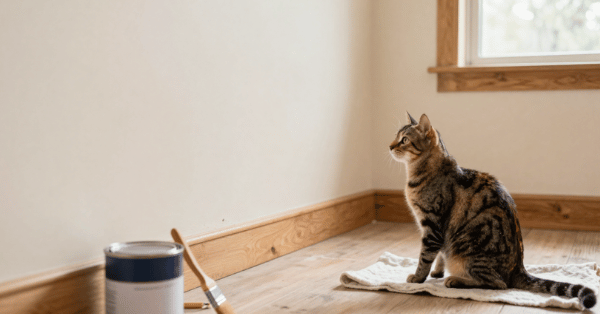
Our cat, meanwhile, has discovered that I radiate heat. According to my wife, I am apparently a “portable furnace.” The kitten agrees. She camps on my lap while I work, converting me into a heated workstation.

However, this same angel becomes chaos incarnate at night. She developed the charming habit of attacking her toy mouse at 2:00 AM directly on our bed. Nothing says deep sleep like sudden feline warfare.

My solution: confiscate the mouse before bedtime.

Her solution: hide the mouse somewhere I can’t find it.

She’s entering what my wife calls “cat adolescence”—a stage characterized by selective hearing and bold experimentation. Recently, she’s decided that kitchen counters are now part of her sovereign territory. She’s stronger and more muscular than our older cat and enjoys launching herself onto elevated surfaces like a tiny Olympic gymnast.

The problem arises when I’m cooking.

There is something mildly alarming about a cat leaping toward the counter while I’m holding a knife. I gently relocate her to the floor. She complains loudly, as if I’ve unjustly exiled her from culinary greatness.

Between the cold house, strategic planking, and a counter-climbing kitten, winter remains lively.

At least I’m never bored.

How Not to Miss a Nephrologist Appointment and Routine

Brian’s fitness journal after a brain stroke

Today, I’m doing something slightly less athletic but arguably just as important: planning tomorrow.

I have a nephrologist appointment in the early afternoon, which means tomorrow’s run is officially cancelled. When your kidneys are less than cooperative, you don’t negotiate with specialists—you show up. I see my nephrologist four times a year to make sure my kidneys are still doing their job and haven’t quietly decided to go on strike.

I was supposed to see him in December. That appointment? Completely forgotten.
The lab work, at least, got done—my wife made sure of that—but the results weren’t great. My kidney function had dipped back into Stage 4 territory, which understandably worried her. When numbers go down, her stress level goes up.

Missing that appointment was not something I wanted to repeat.

So this time, I’ve deployed redundancy like a NASA launch:
  • Phone alarm 
  • Calendar reminder 
  • Morning check-in alert 
  • Uber is scheduled in advance 

If I miss this appointment, it won’t be due to a lack of safeguards. If this system works, it may become the standard operating procedure for all future medical visits.

I don’t want to miss these appointments for three reasons:

  1. I need to understand what’s happening with my kidneys.
  2. I’ve accumulated a respectable list of questions.
  3. Uncertainty scares my wife far more than bad news with context.

On the positive side, my other biometrics look solid. My weight is stable. Blood pressure has been well-behaved. Heart rate is calm and cooperative. So while the kidneys demand attention, the rest of the system seems content.

Yes, I’m a little annoyed about skipping my run—but these appointments are rare enough that missing one workout won’t derail anything. And, conveniently, tomorrow’s forecast is rainy, which takes some of the sting out of it.

Sometimes progress isn’t about doing more—it’s about showing up where it matters most, even if that means trading running shoes for a waiting room chair.

A Rainy Morning Run and a Strong Finish Elsewhere

Brian’s fitness journal after a brain stroke

Despite the heavy rain early this morning, my wife still went out for her morning exercise—and got thoroughly soaked. She owns a proper running jacket designed for rain and snow, a relic from her years in Canada. Unless there’s ice on the road, the weather is more of a suggestion than a deterrent for her.

I, on the other hand, was mildly concerned about becoming a soggy runner.

By the time I headed out, the rain had cleared completely—and somehow it was warm enough for shorts. A rare weather plot twist. Unfortunately, this unexpected kindness from the sky did not translate into a target-paced run.

Running pace is a fragile thing. Sleep quality, body condition, temperature, humidity—almost anything can tip it off balance. If I don’t sleep well, my pace suffers. If the weather shifts suddenly, my pace notices. So I try not to get too discouraged when a run doesn’t go exactly as planned.

Today was one of those days.

Still, the workout wasn’t a loss. Pull-ups were on the schedule, and those went well. I completed all 21, finishing the first 10 without dropping off the bar—a small but satisfying benchmark. Planking and stretching followed, both completed without complaint from my body.

While the run didn’t cooperate, the rest of the system performed.

I’ll have one more chance this week to hit my target pace. Tomorrow’s weekly 10K will be the real test. If I can’t hit my goal across the full distance, I’m hoping to at least lock it in for one strong half.Not every run is fast.
Not every workout shines.
But consistency still counts—and today, that box is firmly checked.

Pull-Ups, Greed, and the Fine Art of Pushing Just Enough

Brian’s fitness journal after a brain stroke

I woke up a few minutes early this morning, which already put me in a suspiciously good mood. Mondays usually require negotiation. Today did not. Today was pull-up day.

That meant I had a decision to make.

I’d originally set my goal at 20 pull-ups—a nice, round, respectable number. I hit that last week. So the question was simple:
Do I maintain… or do I get greedy?

Before my brain stroke, I used to follow a program called P90X. I had one of those doorway pull-up bars—the kind that makes you question both engineering and your doorframe. A year before my stroke, my wife upgraded me to a proper exercise bar. Then the stroke happened. The bar sat unused. Later, it was dismantled when we moved to Nashville.

For a long time, upper-body strength wasn’t even on the agenda.

First came walking—with a walker.
Then walking with my wife’s support.
Then a stick.
Then jogging.
And now… 10K runs.

A few years ago, I pulled the equipment back out and reassembled it. At first, pull-ups were brutal. Awkward. Humbling. But slowly—quietly—they came back.

Here’s the strange part:
I can now do more pull-ups than I could before my stroke.

That still surprises me.

So this morning, being appropriately greedy, I went for 21.

I completed the first 10 without dropping from the bar and immediately felt victorious enough to justify the decision. When you push just beyond what you think you can handle—not recklessly, but deliberately—your body often agrees to the negotiation.

The remaining 11 came in two bursts:
6 pull-ups, a few seconds of existential bargaining, then 5 more.

Done.

I’m still careful. I have to be. My kidneys mean I can’t overwork muscle tissue or recover like a typical athlete. Cardio and resistance training are good for me—but excess is not. Everything lives in the margins of balance.

Still, this kind of pushing works for me.

For now, I think I’ll keep increasing the count each week—at least until I can comfortably complete two clean sets of 10 with only a short break between them.

After that?
We’ll renegotiate again.

That’s how progress works—not in straight lines, but in small, stubborn decisions made on ordinary Monday mornings.

A Skunk Alarm Clock and My Fastest Start to a New Year

Brian’s fitness journal after a brain stroke

My New Year didn’t start with an alarm clock—it started with a skunk alert.

About an hour earlier than I planned to wake, my wife called me to open the garage door so she could get back into the house after her morning walk. Apparently, she’d spotted a skunk casually loitering near our front porch and decided that direct negotiation was not the safest strategy.

Reasonable.

She’d just returned from her morning exercise, and it was still dark outside. When I turned on the porch light, the skunk immediately fled—clearly not interested in confrontation or homeownership. Crisis resolved. Sleep, however, was not.

Being awake an hour early left me groggy and disoriented, but I did my best to reset into my normal routine. Eventually, I laced up and headed out for my run.

And then something unexpected happened.

The first quarter kilometer felt fast—suspiciously fast. I checked my pace and realized I was already about 30 seconds ahead of my target. Concerned I might burn out early, I shifted focus to simply maintaining speed instead of chasing numbers.

By the end of the first kilometer, I was over a minute ahead of my target pace.

At the two-kilometer mark, my average pace had dropped below 8 minutes per kilometer. That’s the kind of number that starts doing dangerous things to your optimism. If I could hold it for another three kilometers, I’d set a new personal best and potentially smash my end-of-year goal on the first run of the year.

That part felt slightly unreal.

I couldn’t quite maintain that pace through the final kilometer and drifted back above 8 minutes per kilometer—but it didn’t matter. I still set a new personal best and ran significantly faster than my previous run on Wednesday.

More importantly, it confirmed something:
If I just keep doing what I’m doing, my goal is absolutely reachable.

I only need to shave 22 seconds off my pace to hit sub-9 minutes per kilometer.

That’s not magic.
That’s consistency.

For a year that began with a skunk encounter and a disrupted sleep cycle, it turned into a surprisingly perfect first run. Strong, fast, confident, and full of momentum.

Not a bad way to start a new year at all.

Ending the Year Shaking, Sweating, and Still Standing

Brian’s fitness journal after a brain stroke

Being the very last day of the year, I decided it was now or never.

I added a few extra seconds to my planking session and went for my first three-minute plank. I’d been hoping to reach this milestone before the year ended, and since calendars are unforgiving, today was my final chance.

It took three attempts.

On the third try, I summoned every ounce of stubbornness I possess and held on through the shaking, bargaining, and quiet questioning of my life choices. But I made it. Three minutes. Done.

It’s strange how quickly a year disappears when you look back at it. Somehow, I managed to achieve all the goals I set for myself this year. Tomorrow, the slate resets—but today, I’m allowing myself to acknowledge that effort matters.

Feeling fairly triumphant, I headed out for my run, hoping to double the celebration by matching my target pace. That didn’t quite happen. Still, I achieved a sub-9-minute-per-kilometer pace, which was my primary running goal for the year. That counts.

My wife and I both set goals—but in very different ways.

I tend to set yearly goals, supported by smaller milestones that I adjust as needed. Physical progress isn’t linear. Sometimes you move forward, sometimes you stall, and sometimes you need to force a milestone just to see what’s possible.

My wife doesn’t really think in years. She thinks in decades.

Her goal is simple and ambitious: at 80, she still wants to enjoy moving her body. From there, she works backward—long-term vision, then mid-term goals (three to seven years), then short-term ones. She says that after 50, you really have to focus on the next zero to three years, because anything can happen. We share the same personality type—INTJ—but her timeline makes mine look impatient.

Still, I’m satisfied.

This Friday, I’ll begin a new year-long quest: shaving another minute off my pace. It will be hard. Possibly frustrating. But as long as I’m making progress, I’ll be content—even if I don’t fully succeed.

And if I don’t? I’ll try again next year.

What’s remarkable is that my slowest runs over the past couple of weeks would have ranked among my fastest runs at this time last year. Progress has happened, even when it didn’t feel dramatic.

So I’ll end the year the same way I lived it:

  • a little stubborn
  • a little reflective
  • and still moving forward

Nashville Weather Changes: Spring Yesterday, Winter Today

Brian’s fitness journal after a brain stroke

True to the forecast, the temperature dropped 40 degrees since yesterday. This is classic Nashville behavior. Our weather doesn’t transition—it teleports. One day you’re contemplating spring allergies, the next you’re questioning your glove choices.

Just yesterday, it felt so warm that we spotted early spring flowers on the trees. My wife’s allergies immediately noticed. Apparently, pollen doesn’t wait for official permission. Spring showed up briefly, caused chaos, and left.

The shift happened fast. It stayed warm through the evening, but around 10 p.m., the wind started howling like it had a personal vendetta. The temperature plunged, and for a while, I was mildly concerned about losing electricity. My wife, meanwhile, slept soundly through it all—completely unaware of the weather drama unfolding outside.

To be fair, she had already checked today’s temperature before bed. She always does. Her running clothes are selected and staged based on the forecast, prepared calmly in advance like a seasoned field commander.

This morning, I waited for the day to reach its warmest point—which was still just below freezing—then reluctantly pulled on my gloves and headed out for my run. I was annoyed, but annoyance is practically a Tennessee weather survival skill.

Sometime overnight, a large branch snapped off a tree behind our house. I’m fairly certain I heard it crack. The tree itself survived, thankfully—it chose to sacrifice an arm rather than topple over onto our deck or house. Strategic, if unfortunate.

In the daylight, the damage was clear. The tree lost its largest limb and now looks thoroughly defeated. It was already struggling against neighboring trees, and since the one next to it fell last year, the ground may be too disturbed for it to stay upright much longer. This is likely a conversation I’ll need to have with my wife later.

On a brighter note, her Christmas present finally arrived today. I wrapped it up so it’ll be ready when she gets home—a small victory amid the wind, cold, and fallen branches.

So yes:
  • Yesterday: spring
  • Today: winter
  • Tomorrow: who knows

That’s Nashville. And somehow, we keep running anyway.

Running After Poor Sleep and Even Less Patience

Brian’s fitness journal after a brain stroke

Some days, sleep simply refuses to cooperate. Last night was one of them.

I woke up around 1 a.m. and stayed awake for hours, staring into the darkness while my brain ran its own unsolicited marathon. By morning, my body made it very clear that it had not signed up for this level of sleep deprivation.

Fridays come with their own fixed set of chores, and today was no exception. My wife took the day off—strategically—because she needs to work an extra day next week. She had already been up for hours, moving briskly through chores she scheduled a month ago. That’s just how she operates. Planning is her superpower.

Despite feeling tired down to my bones, I got up at my normal time. Routine has a way of carrying you when energy doesn’t. After breakfast, I felt marginally more human and decided to go for my run. This was not enthusiasm—it was willpower.

My wife, already finished with her morning exercise, cheerfully reported how wonderful it was outside. And she was right. By the time I stepped out, it was already above 65°F—shockingly warm for winter in Tennessee. She’s thoroughly enjoying this mild American winter, having lived in Canada long enough to expect a white Christmas.

I remember Canadian winters vividly. One year, we shoveled nearly a foot of snow. If you live in the snow belt, snow removal becomes a lifestyle choice.

Today’s run felt great weather-wise. Shorts made another appearance. Speed, however, did not. I didn’t hit my target pace, and I’m placing full responsibility on poor sleep and lingering exhaustion.

My wife mentioned the other day—backed by her usual deep dive into nearly 100 academic journals—that sleep quality has a direct impact on cardio and resistance training performance. She doesn’t repeat common wisdom; she verifies it. That level of professional skepticism likely comes from her accounting background. Admirable? Yes. Exhausting? Also yes.

Despite the fatigue, I managed to complete everything on today’s to-do list. Still, there was a quiet sense of dread hovering over the day—the kind that only poor sleep can bring.

Now that it’s early evening, I’m nearly caught up. Once I finish my pullovers, I’ll officially be in the clear. The hope is simple: better sleep tonight, a stronger run tomorrow, and fewer arguments with my pillow.

One tired day down. Tomorrow gets another shot.

Running in Shorts on Warm Christmas Eve (and Other Seasonal Confusions)

Brian’s fitness journal after a brain stroke

It’s eerily warm this Christmas Eve—warm enough that I ran in shorts. Seasonally inappropriate, yes. Thermodynamically accurate, also yes.

When I woke up, my nose felt congested. After one decisive blow, it started bleeding. Festive. I’m blaming the unusually low humidity we’ve had over the past few weeks. My skin has also been itchy enough to qualify as a minor distraction, though lotion keeps things from escalating.

This Christmas in Nashville has been strange. One day we hit the high 60s Fahrenheit, which immediately reminded me of Vancouver, where we lived briefly. Vancouver summers rarely go above 72–73°F, so a nearly 70-degree day there feels like a heatwave. Today had that same confused energy—winter pretending to be spring.

I did pause to worry about the nosebleed. These days, anything involving blood earns a moment of concern. Nosebleeds can signal high blood pressure, but after checking, mine was fine. Dryness seems to be the real culprit.

My wife, ever the source of oddly specific medical trivia, once told me she used to get nosebleeds from eating too much chocolate. She also had frequent nosebleeds during sudden temperature or pressure changes—so frequent, in fact, that she had the nasal veins cauterized in her teens. She hasn’t had a nosebleed since, though she remains cautious around chocolate and rapid weather shifts.

I worry more than I used to. Knowledge does that to you. Once you know what could be wrong, your brain insists on checking every possibility.

Unfortunately, my run didn’t go particularly well either. I felt distracted and held back, partly because I was worried my nose might start bleeding again if I pushed too hard. Running in shorts usually feels like an automatic speed boost, but not today.

Still, it wasn’t a total loss. I matched Monday’s pace, which means there’s at least some improvement from earlier this week. And with three more runs before the week ends, I still have chances to hit my target pace.

So:

  • Warm Christmas Eve ✔️
  • Shorts in December ✔️
  • Festive nosebleed ✖️
  • Perfect run ❌

Not ideal—but manageable. And on Christmas Eve, that’s good enough.

Holiday Baking for Family, and the Quiet Joy of Making Pie

Brian’s fitness journal after a brain stroke

Today’s most important task wasn’t glamorous—but it was meaningful:
I peeled, sliced, and macerated apples for tomorrow’s apple pie.

We’re heading to my sister’s house for a Christmas party, and my official contribution is two pies: one apple, one pumpkin. Sadly, my mother won’t be able to come this year because she has the flu and doesn’t want to share it with the rest of us. That’s disappointing—but also considerate. Germs are not festive.

I was still excited, though. I used this same apple-pie process for Thanksgiving, and my brother-in-law—a genuinely excellent cook—complimented it. That is high praise. When someone who regularly feeds everyone beautifully enjoys something you made, it hits differently.

So yes, I’m happily attempting a repeat performance.

I always prep pies two days ahead. Pies, like good ideas, improve with a little patience. The day before baking, I macerate the apples—letting sugar and spices pull out their juices and soften them overnight. Tomorrow, all I have to do is assemble and bake.

The pumpkin pie required a small compromise this year. We didn’t make our own pumpkin purée like usual. Everyone was too busy, and even applesauce didn’t happen. So we bought purée from the store. Is it as romantic? No. Is it acceptable? Absolutely.

I love baking for family gatherings. It’s how I show up. I’ve loved baking since I was a teenager, and after my brain stroke—when I couldn’t even draw a proper clock—I still baked my wife a birthday cake with my father’s help. Baking gave me structure, sequencing, and purpose. In a very real way, it became part of my rehabilitation.

There’s something deeply grounding about measuring, mixing, waiting, and watching something become whole.

I can’t believe the year is almost over. The best parts of the holidays are still ahead. My wife is already excited to see her niece—she only gets that chance during family gatherings because life is so busy for everyone.

For now, I’m content with bowls of spiced apples resting quietly in the fridge, doing their slow magic.

It feels good to contribute something made with care to people I care about—even if it’s just pie.