
How Small Weekly Gains Build Muscle and Momentum

Day 49 of 100 Days Muscle Resistance Workout Challenge

Focus Topic: Review your week’s incremental changes and note how your body adapted.

Learning Material 

Progress doesn’t happen in leaps; it happens in layers. This week focused on progressive overload, the small, consistent increases in weight, time, or effort that teach your body to adapt. These micro-progressions, adding just 2–5% more intensity, may seem insignificant day-to-day, but they trigger a cascade of growth responses in your muscles and mind.

When you challenge your muscles slightly beyond their comfort zone, tiny tears occur in the muscle fibers. During recovery, your body repairs these tears stronger than before, a process called muscle adaptation. But this only works if the increase is gradual. Overdoing it causes strain; underdoing it leads to stagnation. The key is to listen closely to your body’s feedback, the difference between discomfort (growth) and pain (injury).

Psychologically, momentum builds confidence. Each time you meet a small challenge, your brain releases dopamine, a reward signal that reinforces motivation. Over time, this creates what sports psychologists call a “success spiral.” Each small win increases your belief that bigger wins are possible. I remember learning about “Flow” while taking MBA courses. While I do not depend on my motivation to do things, I cannot deny that the flaw makes me more productive and energized.

Example:
Think of your training as stacking bricks. Adding one brick per day may look slow, but a steady stack builds a wall. If you throw too many at once, the wall collapses. Athletes who sustain long-term progress master this “slow stacking” principle, balancing effort with patience.

My Reflection

In my past, I used to work out a lot, but I had conflicts with time or injury, and ended up giving up on muscle workouts. This time, I started with a little increment. I sometimes get a period when I don’t have any muscle ache at all. No problem, I just adjust them. The important thing is to monitor how I feel and look at the progress.

I still have trouble maintaining my muscle mass, but I noticed that even though I overeat once in a while, I don’t gain much weight anymore. However, I am so careful, as my weight decreases along with my muscle mass. I sometimes eat more protein or carbs, knowing it may exceed my daily calories, to gain back my muscle mass.

With the little workout I do, my body seems to adapt to this new habit. Tomorrow, I will do a bit more workout as that was the plan created this weekend. I cannot wait to see if I get muscle aches from it. 

Biometric data

Change in Weight from Day 1: -3.4 lb.
Skeletal Muscle: 39.3%
Muscle Mass: 94.4 lb.

Adjustment Ideas (Strategic Adjustment)

  1. Training: Continue gradual progression by adding only one small change next week — a few more reps, slightly heavier weight, or longer hold time.
  2. Diet: Increase protein intake slightly on training days to support recovery (e.g., an extra 10–15g of lean protein).
  3. Mindset: End each session by acknowledging one improvement, no matter how small. Reinforcing progress strengthens both motivation and self-awareness.
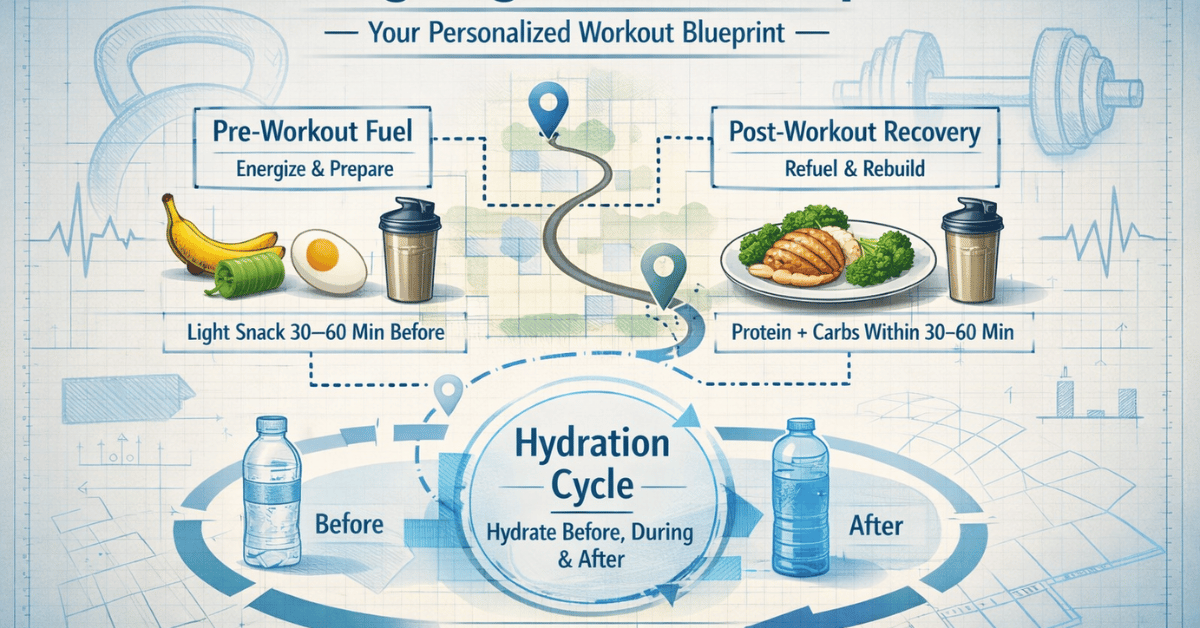
Designing Your Fuel Map: Build a Personalized Workout Fueling Blueprint

Day 42 of 100 Days Muscle Resistance Workout Challenge

Focus Topics: Review what pre/post-workout meals or hydration strategies worked best.

Learning Material 

By now, you’ve learned that nutrition isn’t just about what you eat; it’s about timing, balance, and feedback. Last week focused on understanding your body’s relationship with energy: how hydration supports endurance, how carbs fuel performance, and how protein rebuilds strength.

Now it’s time to bring all these insights together and create your personal fueling blueprint, a system tailored to your body’s rhythm, workout style, and goals. Think of this as your “map” for sustainable progress.

Key Insight

1. Find Your Pre-Workout Sweet Spot

Not everyone thrives on the same pre-workout strategy. Some feel best training fasted, while others need a small carb or protein boost beforehand. The key is understanding how your body responds to fuel timing.

  • If you train early in the morning: Try a light, easily digestible snack, like a banana or protein shake.
  • If you train later in the day: Focus on a balanced meal 2–3 hours before training with carbs (for energy), protein (for muscle protection), and some fat (for sustained fuel).

Research shows that even small pre-exercise meals improve muscle activation and endurance by maintaining stable blood sugar and reducing fatigue.

Key Insight 1: Experimentation builds awareness. Your body’s “fuel pattern” is unique; listen, track, and adapt.

2. Perfect the Post-Workout Window

Recovery begins the moment your workout ends. The goal is to replenish glycogen, repair muscle tissue, and restore hydration. Studies indicate that consuming protein and carbohydrates shortly after exercise enhances muscle protein synthesis and glycogen replenishment more effectively than delaying intake for several hours.1

Effective recovery combinations:

  • Greek yogurt + fruit
  • Chicken + rice bowl
  • Protein shake + banana
  • Tofu + sweet potato

If you work out intensely or multiple times per week, adding electrolytes or lightly salted water can further support recovery.

Key Insight 2: Think of your post-workout meal as a continuation of your workout—it’s part of the training, not the reward after it.

3. Hydration: The Constant Factor

Your energy and performance fluctuate with hydration. Even mild dehydration (as little as 2% body weight loss) can cause noticeable drops in power and endurance.

A good guideline:

  • 2 cups (500 ml) of water before exercise
  • Small sips every 15–20 minutes during exercise
  • 2–3 cups after, adjusted for sweat loss

Add electrolytes if your sessions last over an hour or you sweat heavily. Remember, hydration isn’t just about replacing water. It’s about restoring balance.

Key Insight 3: Hydration consistency is like charging a phone; you can’t expect full power if you only plug in when the battery’s already dying.

Real-World Example: The “Goldilocks” Athlete

One runner kept struggling with energy crashes mid-race. After journaling her nutrition, she realized she was under-fueling pre-run but overloading post-run. By adjusting her intake, half a banana before training and a recovery shake afterward, she found her “just right” balance.
Her endurance improved, and recovery time dropped significantly.

Like her, your goal this week is to identify your “Goldilocks zone,” the nutrition rhythm that feels sustainable, not forced.

My Reflection

Having a morning snack has been a challenge for me. If I want to make it a consistent habit, I’ll need to adjust my routine altogether. I’ve been weighing myself after workouts to keep track of my progress, but I realize it might be more accurate to weigh myself before exercising and after eating a small pre-workout snack.

My favorite meal combination is eggs and salad, simple but effective. I use balsamic vinegar and black pepper as a dressing, which adds nice flavor without extra calories. Eggs are my go-to because they provide a solid amount of protein, and I prefer eating them before starting work since I can’t cook once my workday begins.

I also have strawberries and homemade yogurt. My yogurt doesn’t contain preservatives or added sugar, which makes it a clean option. The only issue is convenience; I often skip it because it takes about 10 minutes to prepare. I’m planning to cut and portion the strawberries ahead of time so it’s easier to eat in the mornings.

During work hours, I take a plant-based protein shake since it’s quick to prepare and allows me to mix different protein sources.

Last week, I noticed a small reduction in my stabilized weight, but also a slight drop in muscle mass. I’ll continue monitoring both closely and stay mindful of my eating habits. Food journaling helps me see patterns clearly.

I also increased the weight for my leg workouts this week since I wasn’t feeling muscle soreness anymore. I’m curious to see if the new adjustment will stimulate better results.

Biometric data

Change in Weight from Day 1: -3.2 lb.
Skeletal Muscle: 39.3%
Muscle Mass: 94.6 lb.

Adjustment Ideas (Strategic Adjustment)

  1. Refine Your Timing: Adjust pre-workout fuel 30 minutes earlier or later and note performance changes.
  2. Prioritize Recovery: Prep a ready-to-go post-workout protein or carb option so you never skip your refueling window.
  3. Hydrate with Intention: Track daily water intake (aim for half your body weight in ounces) and note how it affects energy and muscle soreness.

Note

  1. Ivy, John L., Howard W. Goforth Jr., Bruce M. Damon, et al. “Early Postexercise Muscle Glycogen Recovery Is Enhanced with a Carbohydrate-Protein Supplement.” Journal of Applied Physiology 93, no. 4 (2002): 1337–1344. https://doi.org/10.1152/japplphysiol.00394.2002 ↩︎