
Why Sleep Matters for Muscle Recovery, Stress, and Long-Term Health

Day 89 of 100 Days Muscle Resistance Workout Challenge

Focus Topics: Sleep Matters For Muscle Recovery. Learn how sleep supports muscle recovery, lowers stress, and improves mental clarity. Discover why deep sleep is essential for strength and health.

Learning Material: Sleep Matters for Muscle Recovery

Most people treat sleep as optional downtime—something to squeeze in after everything else is done. But biologically, sleep isn’t rest from training.
It’s the phase where training actually counts.

If training sends the message, sleep is when the body replies.

Key Insight

1. Muscle repair happens while you sleep

During deep sleep, your body releases growth hormone, repairs damaged muscle fibers, replenishes glycogen, and regulates inflammation. This is why:

  • You can train hard and still lose muscle if your sleep is poor
  • Muscle soreness often decreases after a good night’s sleep
  • Deep sleep often follows days when your body truly needs repair

Without enough sleep, your body shifts into survival mode. In survival mode, muscle preservation is not a priority.

2. Sleep regulates stress hormones

Sleep is the main brake on cortisol.
When sleep is short or fragmented:

  • Cortisol stays elevated
  • Recovery slows
  • Fat storage increases
  • Muscle breakdown becomes more likely

This explains something you’ve already observed: when stress and sleep are off, muscle mass fluctuates wildly—even if training stays consistent.

3. The brain recovers, too

Sleep isn’t just physical maintenance—it’s emotional and cognitive processing. During sleep:

  • The brain sorts stress
  • Emotional reactivity decreases
  • Focus and coordination improve

That’s why workouts feel easier after good sleep—and why poor sleep makes everything feel heavier, mentally and physically.

A Real-World Example

Think of your body as a factory.

Training is the day shift—it creates demand and wear.
Sleep is the night shift—it repairs machines, restocks supplies, and upgrades systems.

Skip the night shift too often, and no amount of daytime effort saves the factory. Eventually, things break.

My Reflection

For the past three weeks, there’s one area I haven’t been handling well: sleep. I still fall into the habit of using my phone at night, even on days when I’ve already spent time reading. That small behavior has been enough to interfere with my rest.

When I sleep well, the difference is obvious. My mind feels sharper, my mood is steadier, and I have far more energy for my morning walks. This week reminded me how sensitive my body is to small disruptions. We had a dinner meeting on Thursday, and eating later than usual threw off my rhythm. Little changes like that have a bigger impact on sleep than I often expect.

Although eating more at night can support muscle growth, I was so tired that evening that I ended up scrolling on my phone instead of reading or winding down. Ironically, even with that level of fatigue, the phone kept me from sleeping deeply.

Going forward, I’m going to set a strict cutoff time for phone use at night. If I want better recovery and better training, I need to protect my sleep as intentionally as I protect my workouts.

Biometric data

Change in Weight from Day 1: -6.0 lb. 

Skeletal Muscle: 39.7%

Muscle Mass: 93.6 lb.

Adjustment Ideas (Strategic)

Choose one for the coming week:

  1. Protect a fixed bedtime window
    Even 20 minutes earlier can dramatically change recovery.
  2. Reduce nighttime stimulation
    Replace phone scrolling with low-stimulus activities (stretching, quiet reading, breathing).
  3. Pair hard training with intentional sleep On days you train harder, consciously increase sleep priority—not intensity.
A Packed Agenda: Running, Dentists & Cupcakes in Nashville

Brian’s fitness journal after a brain stroke

Some mornings hand you a packed agenda and dare you to keep smiling. Today was one of those mornings, and I’m pleased to report I made it through with my teeth cleaned, my legs exercised, and a box of cupcakes in hand. Let’s call it a win.

I walked to the dentist, as I almost always do. One of the quiet joys of living in Nashville is having my doctor and dentist both within easy walking distance. There’s something deeply satisfying about a medical appointment you can stroll to. Because it feels virtuous even before anyone pokes around in your mouth.

I left a little early to pad the schedule, which turned out to be wise (or lucky — hard to say). There was a scheduling hiccup on their end, and I ended up waiting an extra fifteen minutes. To their credit, the office made it right with a Starbucks gift card. Unexpected, appreciated, and honestly a little charming.

Then came the cupcakes. Every time I visit the doctor or dentist, I treat myself to cupcakes from my favorite spot on the way home. It’s my personal reward system, and I stand by it completely. My wife, as always, graciously declined when I offered to bring her some. She keeps a watchful eye on her sugar intake because her grandmother and aunt both dealt with diabetes. So she’d rather not tempt fate. I admire the discipline, but I also admire the cupcakes.

On the walk back, I noticed the crosswalks were being worked on, which made sense, since we’d discovered they were missing entirely when we strolled to the growler refill store on my birthday. Nashville is apparently catching up on its pedestrian infrastructure, one intersection at a time.

A quick but important scheduling note: now that the Nashville heat is properly arriving, I’ve shifted to my summer running schedule. That means lacing up first thing in the morning rather than waiting for later in the day, because waiting means melting, and nobody wants that. So far, the new routine is clicking right along.

There’s always a moment when I see a full day ahead of me and feel that familiar flutter of mild anxiety. But today, I ticked off the run, the appointment, the cupcakes, and the walk home without incident. Tomorrow brings two more appointments, though thankfully no lawn mowing and no required miles. A full dance card, but not an overstuffed one.

I’ll take it.

— Until next time, may your waiting rooms be brief and your cupcakes be plentiful.

Master Proper Lifting Form For Strength Training for Safer, Stronger Gains

Day 53 of 100 Days Muscle Resistance Workout Challenge

Focus Topic: Proper lifting form for strength training

Learning Material 

When people think about lifting, they often focus on the weight itself — how much they can move, how many reps they can do. But the truth is, form comes before force. The difference between a strong, efficient body and one constantly battling pain or fatigue often lies in one word: alignment.

Your muscles don’t act alone; they operate as an interconnected system through your bones and joints. When your alignment is off — even slightly — your body compensates, shifting the load to joints, ligaments, or weaker muscles not designed for that stress. Over time, this leads to tightness, imbalance, and injury.

Proper form isn’t just about avoiding harm; it’s about unlocking power. A well-aligned lift allows your body to channel strength efficiently, recruiting the right muscles at the right time.

Key Insight

1. The Science of Alignment and Force Distribution

Biomechanics research has shown that the way you position your spine, hips, and knees determines how efficiently force is transferred through your body. When your posture is aligned, your skeletal structure supports the load — meaning your muscles don’t have to overwork.

  • Squat: A 2024 study in the International Journal of Sports Physical Therapy found that maintaining a neutral spine and stable knees during squats reduced lower-back stress and increased quadriceps activation.1
  • Deadlift: In a 2020 biomechanical review, researchers found that proper hip hinge technique decreased lumbar compression while improving glute engagement — leading to better long-term strength gains.2
  • Overhead Press: Shoulder alignment (keeping the bar path in line with the midfoot) prevents excessive strain on the rotator cuff and improves overhead stability.

When you lift correctly, your muscles and joints share the load like a well-coordinated team. But when one member “cheats,” others take the hit.

2. The Mind-Body Connection: Lifting with Awareness

Lifting is as mental as it is physical. Many lifters develop poor habits by rushing through reps, letting ego or fatigue override attention to form. Training awareness — paying attention to how each movement feels — sharpens your mind-muscle connection and prevents sloppy mechanics.

Elite athletes use a concept called motor patterning: repeating correct movement patterns at lower loads to reinforce neural efficiency. Once ingrained, these movement “blueprints” guide the body automatically, even under heavier loads.

In short: move well first, then move more.

A Real-World Example: The Architect’s Blueprint

Think of your body as a building and your spine as its foundation. If the base isn’t level, no matter how strong the upper floors are, cracks will appear. Similarly, every lift you perform builds on your “movement blueprint.” Poor mechanics might not show consequences today — but over time, misalignment creates small cracks that limit strength and stability.

Many experienced lifters who return to perfecting their form often find their strength increases again — not because their muscles grew overnight, but because their body stopped leaking energy through poor alignment.

My Reflection

My coach has always emphasized that proper form is essential in every exercise. Good form not only prevents injury but also determines how effective each movement truly is. I’ve been paying closer attention to my technique lately, but I’m considering asking my husband to watch my form or even setting up mirrors in the exercise room to help me monitor it better.

This week hasn’t gone as smoothly as I hoped. I didn’t buy enough eggs, and as a result, my protein intake dropped. Because there are certain foods I still avoid — partly out of caution — I ended up eating far less than I should have. The result was a 0.6-pound loss in muscle mass, which was a real wake-up call.

To avoid this happening again, I plan to make a list of protein-rich snacks I can keep on hand for days when I fall short on calories. I’ll also restock our pantry this weekend to make sure I always have enough protein options available.

Since yesterday’s lesson about joint awareness, I’ve become more conscious of how my body moves, though that focus distracted me a bit during this morning’s brisk walk. Going forward, I’d like to balance awareness with concentration — staying mindful without losing rhythm or flow.

Biometric data

Change in Weight from Day 1: -5.0 lb.
Skeletal Muscle: 39.6%
Muscle Mass: 94.0 lb.

Adjustment Ideas (Strategic Adjustment)

  1. Form Rehearsal Days: Once a week, use lighter weights to focus purely on technique. Think of it as a “practice session” for your nervous system.
  2. Alignment Habit: Before every set, pause for 3 seconds and mentally check your posture: “Feet grounded, spine neutral, core braced.” This mindfulness cue keeps form consistent.
  3. Recovery Awareness: Add gentle mobility or foam rolling for tight areas (hips, hamstrings, shoulders). Mobility supports alignment — they go hand in hand.

Notes

  1.  Rachel K. Straub and Christopher M. Powers, “A Biomechanical Review of the Squat Exercise: Implications for Clinical Practice,” International Journal of Sports Physical Therapy 19, no. 4 (2024): 490–501, https://doi.org/10.26603/001c.94600. ↩︎
  2. Walter Krause Neto et al., “The Impact of Resistance Training on Gluteus Maximus Hypertrophy: A Systematic Review and Meta-Analysis,” Frontiers in Physiology 16 (April 2025): 1542334, https://doi.org/10.3389/fphys.2025.1542334. ↩︎

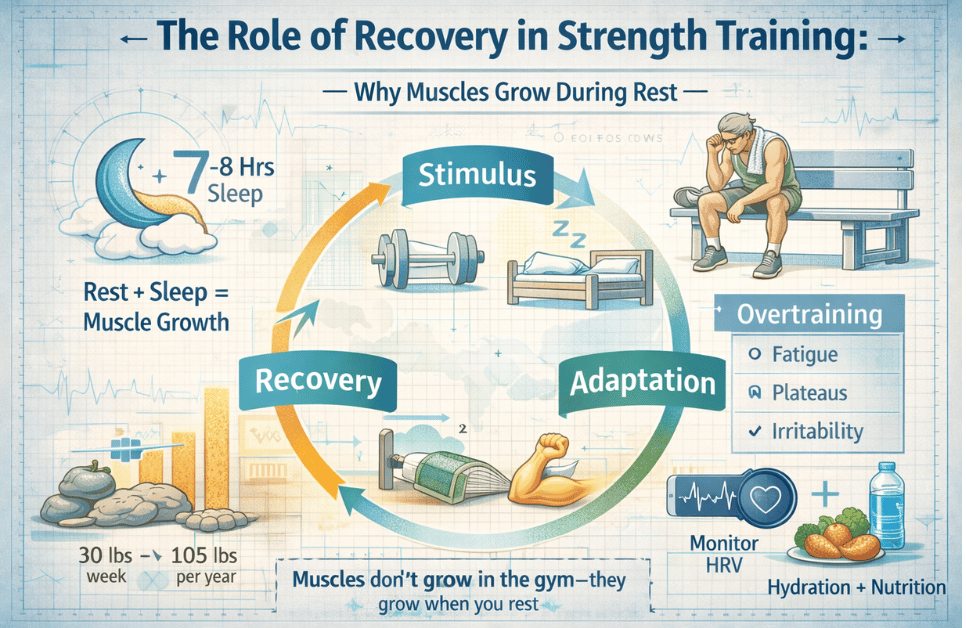
The Hidden Workout: How Recovery Builds Strength

Day 46 of 100 Days Muscle Resistance Workout Challenge

Focus Topics: Recovery Builds Strength. Understand that muscles grow during rest, not training, and progression only works when recovery is balanced.

Learning Material 

When I thought about training, I pictured lifting something heavier, running farther, or pushing harder. After investigation, that is not really true at all. In fact, the true transformation happens when you rest. Training breaks your body down; recovery builds it back stronger. Without proper rest, you’re not training; you’re just accumulating fatigue.

Think of muscle growth as a three-part cycle: stimulus → recovery → adaptation. You create the stimulus by exercising, trigger recovery through nutrition and rest, and achieve adaptation when your body rebuilds itself stronger and more efficient. Neglect any one step, and progress stalls.

Key Insight

1. Muscles Grow When You Sleep

When you train, you create tiny tears in your muscle fibers. During rest, especially deep sleep, your body releases growth hormone (GH), which repairs those fibers and helps them grow back thicker. This is why both sleep quality and quantity directly affect muscle gain, fat loss, and overall performance.

Studies published in the Journal of the American Medical Association (2010) found that even one week of sleep restriction significantly reduced testosterone and growth hormone levels, two hormones crucial for recovery and muscle development.1

Exercise breaks the body down; recovery rebuilds it. Without rest, you’re not getting stronger, but just tired.

2. Overtraining: The Silent Plateau

It’s tempting to think that more is always better, but overtraining can lead to decreased performance, chronic fatigue, and even injury. Your central nervous system (CNS) needs rest as much as your muscles do.

Early signs of overtraining include irritability, poor sleep, loss of motivation, and slower recovery times. Ironically, these are often mistaken for laziness or lack of discipline, when the real problem is that your body is screaming for rest.

A 2018 review in Frontiers in Physiology showed that increasing internal training load in elite football players led to a large increase in cortisol (≈ +102%) and a reduction in testosterone.2

Rest days aren’t “off days.” They’re when the body consolidates progress and prepares for new challenges.

3. The Psychology of Recovery

From a psychological standpoint, recovery isn’t just physical; it’s mental. Scheduled rest builds long-term consistency. People who rest strategically are less likely to burn out and maintain motivation longer because their brains associate training with sustainable effort rather than exhaustion.

Even elite athletes use “active recovery,” low-intensity activities like walking, yoga, or light cycling, to keep blood flowing and aid muscle repair without overloading the system.

Resting mindfully, through sleep, nutrition, and gentle movement, creates the balance that sustains discipline.

Real-World Example: The Marathoner Who Learned to Rest

A professional marathoner once said, “I used to think rest days were for the weak, until I realized they’re why the strong stay strong.” After multiple stress injuries, she restructured her program to include one full rest day and two active recovery days per week. Within three months, her performance improved, and her recovery time between races was cut nearly in half.

The same principle applies to anyone, whether you’re lifting weights, running, or doing bodyweight exercises. Progress is not about constant action; it’s about strategic rhythm between work and recovery.

My Reflection

I used to assume that people who take strategic rest are less likely to burn out. For my workout project, I make it a point to take at least one day off each week when I go into the office. It gives me a built-in reason to pause and feels like the right way to let my body recover.

Thinking about it now, this approach could probably apply to my actual work as well. I juggle both my job and personal business, and I haven’t taken a proper vacation in quite some time, mostly because I’ve been so busy.

Even though I seem mentally steady on the surface, I don’t always check in with myself. Lately, I’ve started tracking my reflections so I can notice what I’m thinking about each day. I tend to mute my emotions, especially at work and in similar responsibilities, and I’m trying to be more aware of it.

Biometric data

Change in Weight from Day 1: -3.8 lb.
Skeletal Muscle: 39.4%
Muscle Mass: 94.4 lb.

Adjustment Ideas (Strategic Adjustment)

  1. Prioritize Sleep: Aim for 7.5–8 hours of consistent, high-quality sleep. Try to maintain a regular bedtime to stabilize hormonal balance.
  2. Add Active Recovery: On rest days, go for a light walk, stretch, or do yoga to promote circulation and ease muscle stiffness.
  3. Monitor Recovery Metrics: Pay attention to HRV (Heart Rate Variability) or readiness scores if you use a fitness tracker. They’re great indicators of when to push and when to rest.

Notes:

  1.  Rachel Leproult and Eve Van Cauter, “Effect of 1 Week of Sleep Restriction on Testosterone Levels in Young Healthy MenFREE,” JAMA 305, no. 21 (2011): 2173–74, https://doi.org/10.1001/jama.2011.710. ↩︎
  2. Amber E. Rowell et al., “Effects of Training and Competition Load on Neuromuscular Recovery, Testosterone, Cortisol, and Match Performance During a Season of Professional Football,” Frontiers in Physiology 9 (June 2018), https://doi.org/10.3389/fphys.2018.00668. ↩︎