
Day 46 of 100 Days Muscle Resistance Workout Challenge
Focus Topics: Recovery Builds Strength. Understand that muscles grow during rest, not training, and progression only works when recovery is balanced.
Learning Material
When I thought about training, I pictured lifting something heavier, running farther, or pushing harder. After investigation, that is not really true at all. In fact, the true transformation happens when you rest. Training breaks your body down; recovery builds it back stronger. Without proper rest, you’re not training; you’re just accumulating fatigue.
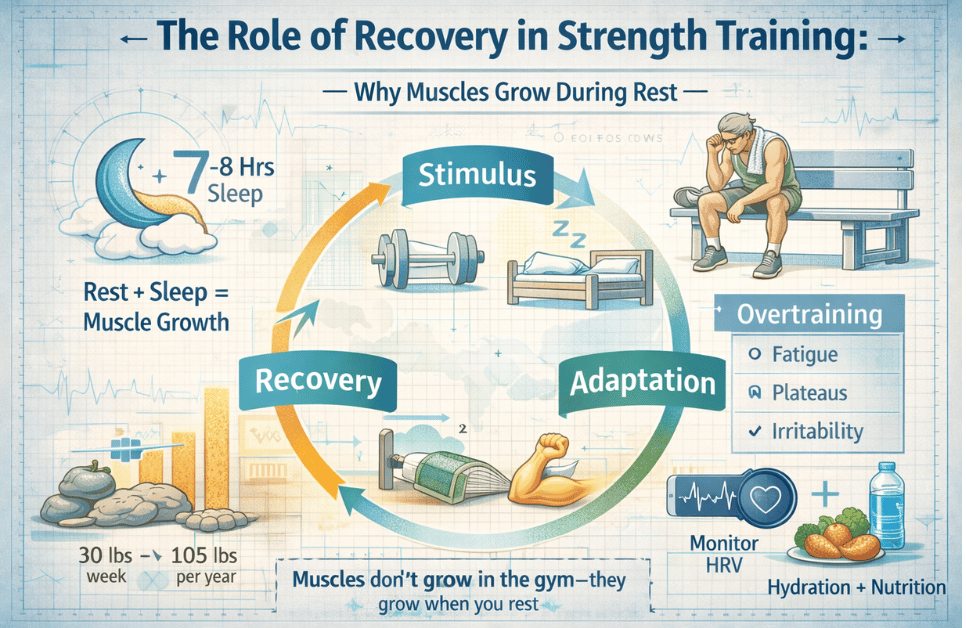
Think of muscle growth as a three-part cycle: stimulus → recovery → adaptation. You create the stimulus by exercising, trigger recovery through nutrition and rest, and achieve adaptation when your body rebuilds itself stronger and more efficient. Neglect any one step, and progress stalls.
Key Insight
1. Muscles Grow When You Sleep
When you train, you create tiny tears in your muscle fibers. During rest, especially deep sleep, your body releases growth hormone (GH), which repairs those fibers and helps them grow back thicker. This is why both sleep quality and quantity directly affect muscle gain, fat loss, and overall performance.
Studies published in the Journal of the American Medical Association (2010) found that even one week of sleep restriction significantly reduced testosterone and growth hormone levels, two hormones crucial for recovery and muscle development.1
Exercise breaks the body down; recovery rebuilds it. Without rest, you’re not getting stronger, but just tired.
2. Overtraining: The Silent Plateau
It’s tempting to think that more is always better, but overtraining can lead to decreased performance, chronic fatigue, and even injury. Your central nervous system (CNS) needs rest as much as your muscles do.
Early signs of overtraining include irritability, poor sleep, loss of motivation, and slower recovery times. Ironically, these are often mistaken for laziness or lack of discipline, when the real problem is that your body is screaming for rest.
A 2018 review in Frontiers in Physiology showed that increasing internal training load in elite football players led to a large increase in cortisol (≈ +102%) and a reduction in testosterone.2
Rest days aren’t “off days.” They’re when the body consolidates progress and prepares for new challenges.
3. The Psychology of Recovery
From a psychological standpoint, recovery isn’t just physical; it’s mental. Scheduled rest builds long-term consistency. People who rest strategically are less likely to burn out and maintain motivation longer because their brains associate training with sustainable effort rather than exhaustion.
Even elite athletes use “active recovery,” low-intensity activities like walking, yoga, or light cycling, to keep blood flowing and aid muscle repair without overloading the system.
Resting mindfully, through sleep, nutrition, and gentle movement, creates the balance that sustains discipline.
Real-World Example: The Marathoner Who Learned to Rest
A professional marathoner once said, “I used to think rest days were for the weak, until I realized they’re why the strong stay strong.” After multiple stress injuries, she restructured her program to include one full rest day and two active recovery days per week. Within three months, her performance improved, and her recovery time between races was cut nearly in half.
The same principle applies to anyone, whether you’re lifting weights, running, or doing bodyweight exercises. Progress is not about constant action; it’s about strategic rhythm between work and recovery.
My Reflection
I used to assume that people who take strategic rest are less likely to burn out. For my workout project, I make it a point to take at least one day off each week when I go into the office. It gives me a built-in reason to pause and feels like the right way to let my body recover.
Thinking about it now, this approach could probably apply to my actual work as well. I juggle both my job and personal business, and I haven’t taken a proper vacation in quite some time, mostly because I’ve been so busy.
Even though I seem mentally steady on the surface, I don’t always check in with myself. Lately, I’ve started tracking my reflections so I can notice what I’m thinking about each day. I tend to mute my emotions, especially at work and in similar responsibilities, and I’m trying to be more aware of it.
Biometric data
Change in Weight from Day 1: -3.8 lb.
Skeletal Muscle: 39.4%
Muscle Mass: 94.4 lb.
Adjustment Ideas (Strategic Adjustment)
- Prioritize Sleep: Aim for 7.5–8 hours of consistent, high-quality sleep. Try to maintain a regular bedtime to stabilize hormonal balance.
- Add Active Recovery: On rest days, go for a light walk, stretch, or do yoga to promote circulation and ease muscle stiffness.
- Monitor Recovery Metrics: Pay attention to HRV (Heart Rate Variability) or readiness scores if you use a fitness tracker. They’re great indicators of when to push and when to rest.
Notes:
- Rachel Leproult and Eve Van Cauter, “Effect of 1 Week of Sleep Restriction on Testosterone Levels in Young Healthy MenFREE,” JAMA 305, no. 21 (2011): 2173–74, https://doi.org/10.1001/jama.2011.710. ↩︎
- Amber E. Rowell et al., “Effects of Training and Competition Load on Neuromuscular Recovery, Testosterone, Cortisol, and Match Performance During a Season of Professional Football,” Frontiers in Physiology 9 (June 2018), https://doi.org/10.3389/fphys.2018.00668. ↩︎