
Day 47 of 100 Days Muscle Resistance Workout Challenge
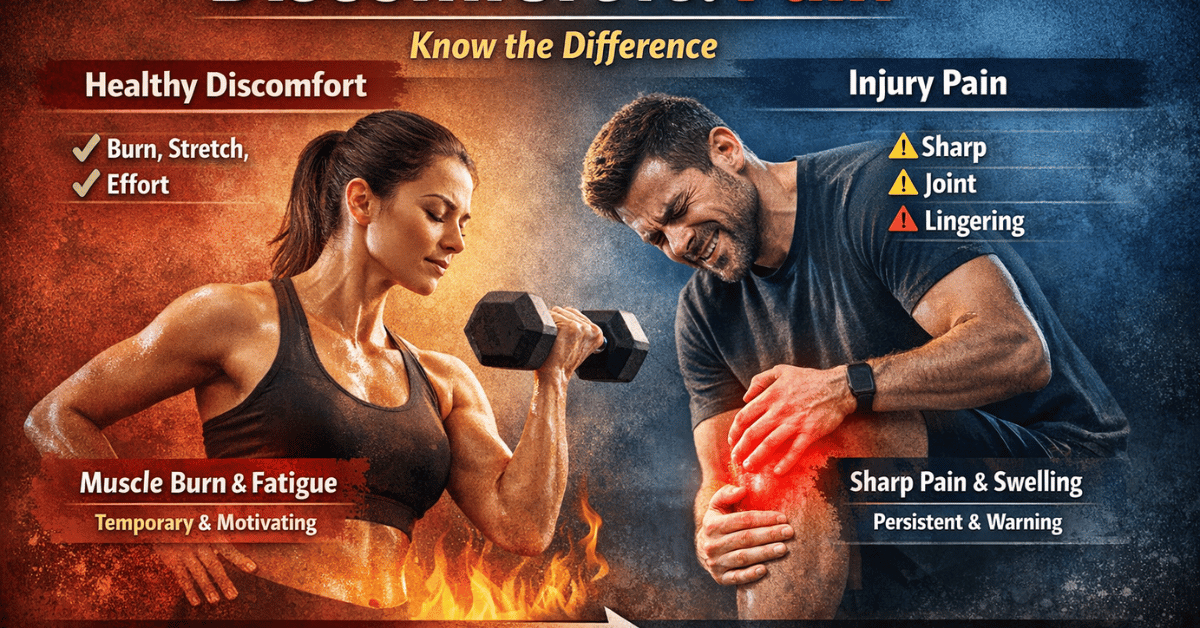
Focus Topic: Discomfort vs. Pain in Strength Training. Learn to distinguish between healthy muscle fatigue (burn, stretch, effort) and injury warning pain (sharp, joint, lingering).
Learning Material
One of the most important lessons in any long-term training program is learning to tell discomfort from pain. It’s the difference between a muscle adapting and a body warning you to stop. The ability to distinguish the two is what separates consistency from injury.
When you train, it’s normal to feel a burning, tightening, or stretching sensation. These are signs that your muscles are working and producing lactic acid as they fatigue. This temporary discomfort is part of the muscle-building process. It signals that your fibers are being challenged beyond their usual capacity, which triggers growth and adaptation.
But pain is different. It’s sharp, sudden, or persistent. It doesn’t fade when you stop an exercise; it lingers. It’s usually felt in joints, tendons, or deep tissues, not in the bulk of your muscles. Pain often means inflammation, strain, or even a small tear, and ignoring it can lead to chronic issues that may sideline you for months.
Key Insight
1. The Science of the “Good Burn”
The burn you feel during a hard set comes from the accumulation of hydrogen ions and lactate as your muscles consume energy faster than oxygen can replace it.
This process (called anaerobic glycolysis) temporarily reduces muscle pH, creating that familiar heat and tension. Once you rest, your blood clears the byproducts, and your body rebuilds stronger muscle fibers to handle future stress better.
Discomfort signals adaptation, your body learning to handle more load.
2. The Biology of Pain: When to Stop
Pain usually involves nociceptors, the body’s specialized nerve endings that detect damage. If you feel a sharp twinge, popping sound, or stabbing sensation, that’s a signal from these receptors. Unlike fatigue, pain does not subside quickly and often worsens with continued motion.
According to the British Journal of Sports Medicine (2017), ignoring early warning pain is one of the strongest predictors of long-term injury. Athletes who “push through” sharp discomfort often experience chronic joint issues or tendinopathies later. (I could not read the method because I can only access the abstract.) 1
During my triathlon training, I developed shin pain from running over 40 km a week. It turned out to be a fractured bone, which forced me to stop training altogether. This experience has made me much more cautious about any type of pain since.
Pain is not a test of mental strength; it’s a request for healing.
3. The Psychology of Sensation
Interestingly, how you interpret pain or discomfort can change how you experience it.
Research in Frontiers in Psychology (2018) found that when athletes reframe discomfort as progress (“this is my muscle learning”), they experience less stress and faster recovery.2
However, if they ignore real pain signals, the brain shifts into a defensive mode, tightening surrounding muscles and slowing recovery.
Awareness, more than tolerance, builds longevity.
Real-World Example: The Runner’s Wake-Up Call
A marathon runner once said:
“I thought my knees hurting after every run was normal. Until I tore a ligament.”
Like many athletes, she mistook chronic joint pain for post-training soreness. When she learned to differentiate the two, she changed her training plan, more stretching, better shoes, and recovery days. The result? Fewer injuries and faster personal bests.
Your muscles grow from challenge; your joints grow from care. Both are essential for sustainable progress.
My Reflection
My muscle mass seems to have plateaued recently. To address it, I decided to increase the weight for my leg exercises, hoping to bring back that familiar muscle ache that signals growth. Since I’m also in weight-loss mode, I’ve been approaching this change cautiously, trying not to lose muscle in the process.
Yesterday, I could almost feel my body asking for more protein, so I listened and had a chicken taco. I worried I might gain weight after that meal, but this morning, both my muscle mass and overall weight dropped.
Looking at my habits, I think I may be eating too few calories, especially since I’ve been avoiding carbohydrates. Until recently, oatmeal was my go-to healthy carb source, but after discovering bugs in the container, I’ve completely lost my appetite for oats. Psychologically, I just can’t eat them now. To fill the gap, I’m planning to make some multigrain rice so I can have a steady, balanced source of carbs again.
In the past, I might have felt “lucky” about losing weight after eating a big meal. Now, I see it differently. Either my stomach feels overly full from small amounts, or I’m becoming more focused on maintaining muscle than chasing lower numbers on the scale. I’m realizing that a calorie deficit isn’t always a win; it can work against my long-term strength goals.
I may need to shift my mindset: instead of aiming to lose weight and gain muscle at the same time, I’ll prioritize building muscle first and then focus on leaning out later. That seems like a smarter, more sustainable path forward.
Biometric data
Change in Weight from Day 1: -4.0 lb.
Skeletal Muscle: 39.4 %
Muscle Mass: 94.2 lb.
Adjustment Ideas (Strategic Adjustment)
- Introduce a Body Check Routine:
Before and after training, scan for any lingering soreness or sharp pain, especially around joints. - Embrace Gentle Recovery:
Add stretching, foam rolling, or a 10-minute walk after workouts to promote blood flow and ease tightness. - Rest with Intention: If you notice sharp or asymmetric pain, replace your next resistance day with active recovery instead of pushing through.
- Amber E. Rowell et al., “Effects of Training and Competition Load on Neuromuscular Recovery, Testosterone, Cortisol, and Match Performance During a Season of Professional Football,” Frontiers in Physiology 9 (June 2018), https://doi.org/10.3389/fphys.2018.00668. ↩︎
- Warhel Asim Mohammed et al., “Effect of Mindfulness Based Stress Reduction (MBSR) in Increasing Pain Tolerance and Improving the Mental Health of Injured Athletes,” Frontiers in Psychology 9 (May 2018), https://doi.org/10.3389/fpsyg.2018.00722. ↩︎